Yunnan and Sumatra are Asia's two most talked-about coffee origins in 2026. One is a rising star rewriting the rules of Chinese specialty coffee. The other is a heavyweight with decades of global recognition and one of the most distinctive processing methods in the world.
But here's the thing: they're more similar than most people realize. Both are Asian. Both grow Arabica at similar altitudes. Both produce low-acid, full-bodied cups. And both have a reputation for earthy, complex flavors that polarize coffee drinkers — you either love them or don't get the hype.
So how do you choose? Let's break down every angle: flavor profile, processing style, growing regions, history, and value.
Quick Verdict
Choose Sumatra if: You crave that bold, herbal, full-throttle earthiness that only Giling Basah processing can produce. Sumatra is for coffee drinkers who want their cup to have personality — even if that personality is "intense."
Or buy both. They're different enough to have on your shelf for different moods. Yunnan for your daily black coffee, Sumatra for when you want a flavor adventure.
Flavor Profile: What's in the Cup
This is where the comparison gets interesting — and where most coffee drinkers develop a strong preference.
☕ Yunnan
- Chocolate & Cocoa — The signature note, from milk chocolate to dark cocoa
- Nutty — Almond, hazelnut, sometimes pecan
- Brown Sugar — Gentle sweetness, never cloying
- Tea-like — A subtle herbal quality reflecting Yunnan's tea heritage
- Low Acidity — Smooth, approachable, easy-drinking
- Medium to Full Body — Satisfying mouthfeel, silky
- Clean Finish — No funky or barnyard notes
🇮🇩 Sumatra
- Earthy & Herbal — The signature note. Cedar, tobacco, sometimes mushroom
- Spice — Clove, cardamom, cinnamon
- Dark Chocolate — Bittersweet, never milk chocolate
- Herbal — Medicinal, sometimes "forest floor" complexity
- Very Low Acidity — Almost none. Smooth as can be
- Heavy Body — Syrupy, full, coating
- Funk — A touch of fermented, wild character
The simplest comparison: Yunnan is comforting — it's chocolate, nuts, and brown sugar in a smooth package. Sumatra is challenging — it's herbs, earth, and spice that demand your attention. Think of it as the difference between a cozy chocolate cake and an adventurous herbal tea.

Two cups from two Asian giants — Yunnan's clean chocolate notes vs Sumatra's bold earthiness. Both low-acid, both full-bodied, but completely different experiences.
Processing Methods: The Key Difference
If you want to understand why Yunnan and Sumatra taste so different despite growing in similar latitudes and altitudes, look at how they process their beans.
Sumatra: Giling Basah (Wet-Hulled)
Sumatra's signature processing method, Giling Basah, is unique to Indonesia and is the single biggest factor in Sumatran coffee's distinctive flavor. Here's how it works:
- Cherries are depulped (skin removed) — standard so far
- The beans, still in their mucilage, are partially dried for just 1-2 days to ~30-40% moisture
- The parchment is removed while the beans are still wet — this is the key difference
- The naked beans are then dried to 11-12% moisture on tarps or mats
Removing the parchment early exposes the beans to more oxygen, accelerating fermentation and creating the earthy, herbal, funky flavor profile that Sumatra is famous for. It also reduces drying time — critical in Sumatra's humid climate.
The trade-off: Giling Basah produces beans that are more brittle and prone to defects. It also creates a very specific flavor that not everyone loves — some call it "dirty" or "barnyard." Others can't get enough of it.
Yunnan: Standard Specialty Processing
Yunnan producers use the standard modern processing methods:
- Washed (Fully Washed) — The most common method for Yunnan specialty. Beans are depulped, fermented in water, washed clean, and dried in parchment. Clean, tea-like, bright acidity. ✨ Most Common
- Natural (Dry Process) — Whole cherries are dried with the fruit intact. Produces fruity, fermented, wine-like cups. Yunnan naturals have improved dramatically since 2022.
- Honey (Pulped Natural) — Some mucilage left on during drying. Balanced between washed and natural in flavor. Torch Coffee's honey-processed lots are world-class.
- Anaerobic & Experimental — Controlled fermentation in sealed tanks. Produces wild, fruity, sometimes boozy flavors. Yunnan is increasingly known for these experimental lots.
Yunnan's processing is cleaner and more controlled than Sumatra's. The result is a more predictable, consistent cup with less "funk" and more clarity of flavor.
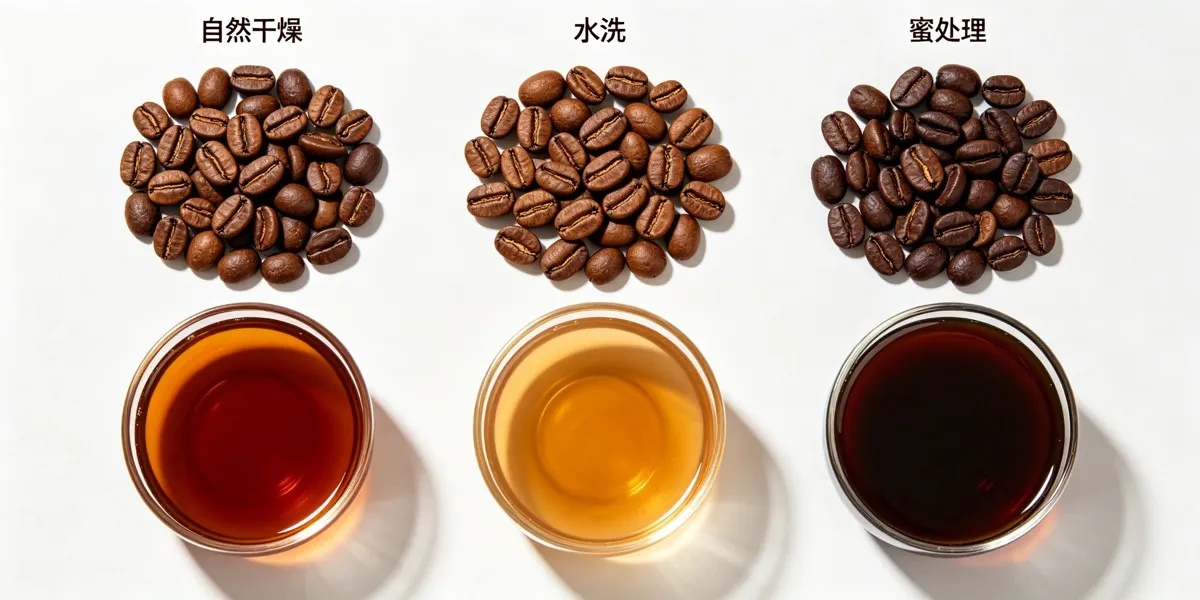
Yunnan coffee processing: washed (left), honey (center), and natural (right). Each method produces dramatically different flavors — far more variety than Sumatra's single dominant processing style.
Growing Regions & Terroir
Yunnan's Four Regions
Yunnan coffee is concentrated in the southwest, along the border with Myanmar and Laos:
- Pu'er (普洱) — Largest region. Chocolate-forward, medium body. 1,000-1,500m.
- Baoshan (保山) — Highest altitude (1,200-1,800m). Brightest, most floral Yunnan cups.
- Lincang (临沧) — Rising star. Clean, caramel-sweet. 1,100-1,600m.
- Dehong (德宏) — Smaller output. Full body, dark chocolate. 800-1,300m.
Yunnan's climate is subtropical with distinct wet and dry seasons. The altitude range (800-1,800m) is lower than top Ethiopian or Colombian regions but comparable to Sumatra's growing areas.
Sumatra's Three Regions
Sumatra's coffee is grown in the highlands along the island's spine — the Bukit Barisan mountain range:
- Aceh (Gayo Highlands) — The most famous region, around Lake Tawar. 1,100-1,600m. Known for clean spice notes, herbal complexity, medium body. ✨ Specialty Heartland
- North Sumatra (Lintong / Sidikalang) — The other famous region, around Lake Toba. 1,200-1,600m. Known for heavier body, more earthiness, and the classic "Sumatra funk."
- South Sumatra (Semendo / Besemah) — Smaller production. Medium body, balanced earthiness. 1,000-1,500m.
Interesting parallel: Both Yunnan and Sumatra grow their coffee in volcanic-influenced soils within similar altitude ranges. The difference in flavor comes down to processing, not terroir.
Price & Value Comparison
| Factor | Sumatra | Yunnan |
|---|---|---|
| Specialty Price (250g) | $10-18 | $6-15 |
| Budget Price (250g) | $6-10 | $4-8 |
| Availability (International) | Excellent — every roaster carries Sumatra | Growing — Amazon & specialty roasters |
| Availability (Asia) | Good — in most Asian markets | Excellent — domestic Chinese market |
| Freshness (International) | Often 3-6 months old at purchase | Often fresher — shorter supply chain |
| Freshness (In China) | Poor — most Sumatran in China is stale | Excellent — roasted within 2 weeks |
| Consistency | Variable — Giling Basah is unpredictable | Good — modern processing, quality control |
| Value for Money | Good — if you find a quality roaster | Excellent — especially in Chinese market |
Which One Should You Choose?
Choose Yunnan if you:
- Prefer clean, chocolatey, low-acid coffee without the "funk"
- Want consistency from bag to bag
- Live in Asia — Yunnan is fresher and cheaper locally
- Enjoy trying different processing methods (washed, natural, honey)
- Are introducing someone to Asian specialty coffee for the first time
Choose Sumatra if you:
- Crave that earthy, herbal, wild flavor only Giling Basah can produce
- Enjoy complex, challenging flavor profiles
- Want the most full-bodied, syrupy coffee you can find
- Drink espresso or milk drinks — Sumatra's body holds up beautifully
- Are a seasoned coffee drinker looking for something with character
Try a washed Yunnan from Baoshan alongside a Aceh Gayo from Sumatra. Brew both in a pour-over. You'll taste the difference immediately — and you'll probably find yourself reaching for the Yunnan more often for daily drinking, while saving the Sumatra for when you want something bolder.
Final Thoughts
Yunnan and Sumatra represent two different philosophies of Asian coffee. Sumatra is the established origin with a signature method that produces unmatched character — for better or worse. Yunnan is the rising star, applying modern processing and quality control to produce clean, consistent, and increasingly excellent coffee.
Neither is objectively better. They're different animals. But if you've never tried Yunnan coffee and you're a Sumatran fan, you might be surprised at how much you enjoy the clean, chocolatey alternative. And if you're a Yunnan regular who's never had a proper Sumatran, you owe it to yourself to experience the Giling Basah magic.
— The Yunnan Coffee Guide Team
📖 Continue Reading
Yunnan vs Indonesia Coffee → Yunnan vs Colombia Coffee → Yunnan vs Ethiopia & Brazil → Yunnan vs Kenya Coffee → Yunnan vs Jamaica Blue Mountain → Yunnan vs Kona Coffee → Yunnan Coffee vs Pu'er Tea → Yunnan Processing Methods → What is Yunnan Coffee? Is Yunnan Coffee Good? Buying Guide →Read next:
- Yunnan vs Indonesia — The Complete Asian Coffee Guide
- Yunnan vs Brazil — Which Origin Should You Buy?
- Yunnan vs Vietnam — Arabica vs Robusta
- Yunnan Coffee Processing Methods — Washed, Natural & Honey
- Catimor in Yunnan — The Complete Variety Guide
- Yunnan vs Guatemala — SHB Hard Bean vs Catimor
- Best Yunnan Coffee Beans (2026)
☕ Try Yunnan Coffee
Explore the best Yunnan single-origin beans on Amazon.
🛒 Shop Yunnan CoffeeAs an Amazon Associate, I earn from qualifying purchases.