July 12, 2026 • 14 min read
How Yunnan Coffee Reaches Global Markets: The Complete Export Journey
Most people don't think about how the coffee in their cup got there. But the story of Yunnan coffee's journey to international markets is one of the most interesting — and fastest-changing — supply chains in specialty coffee.
Here's a number that shocked me: in 2015, less than 5% of Yunnan's coffee was graded as specialty. By 2025, that number had jumped to roughly 25-30%. And the bulk of that specialty-grade coffee now finds its way to roasters in the United States, Japan, South Korea, Australia, and Europe. The infrastructure that made this possible — processing stations, grading labs, export channels — has been built mostly in the last decade.
This guide traces the journey of Yunnan coffee from harvest to international roaster. I've visited farms, talked to exporters in Pu'er, and watched containers get loaded at the Kunming railway hub. Here's how it actually works.
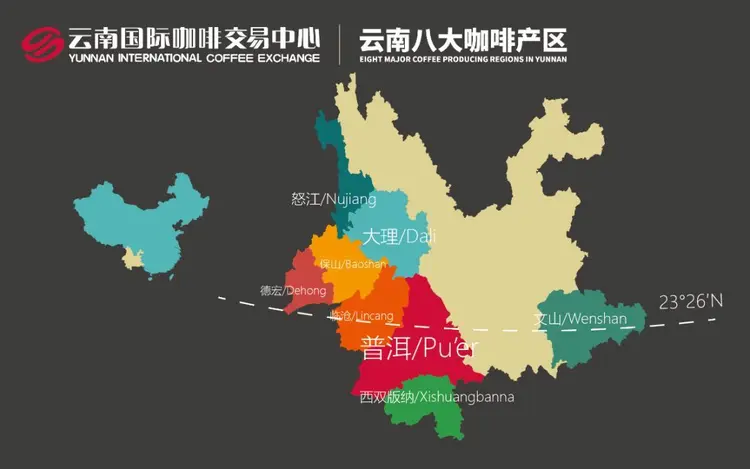
The Yunnan Coffee Supply Chain: Overview
| Stage | Duration | Key Locations | Value Add |
|---|---|---|---|
| 1. Harvest & cherry sorting | Nov-Mar | Farm level (Baoshan, Pu'er) | Ripe cherry selection determines quality ceiling |
| 2. Processing (wet/dry mill) | 1-30 days | Farm or central station | Washed, natural, honey, anaerobic |
| 3. Dry milling & grading | 1-2 weeks | Pu'er city grading stations | Density sorting, screen size, defect removal |
| 4. Cupping & quality certification | 1-2 days | Kunming or Pu'er lab | SCA scoring, lot identification |
| 5. Export logistics | 2-6 weeks | Kunming → Shanghai/Shenzhen port | Containerization, customs, shipping |
| 6. Roasting & retail | Ongoing | International roastery | Roast profiling, packaging, distribution |
Stage 1: Harvest and Cherry Selection
Yunnan's coffee harvest runs from November through March, with peak ripeness in December-January. Most farms employ seasonal pickers from nearby villages. The critical quality decision at this stage: how aggressively to sort ripe cherries from unripe and overripe ones.
At commodity-grade farms, all cherries are strip-picked in one pass — ripe, green, and dried cherries go into the same basket. At specialty-focused farms, pickers return to the same trees multiple times to select only perfectly ripe red cherries. This triples labor costs (from ¥2-3/kg to ¥8-12/kg) but determines whether the lot can score 80+ points.
I've watched pickers at Manlaide farm in Baoshan sort cherries into three buckets: red (perfect), pink (under-ripe), and blemished. The red cherries go into a separate tank for the specialty lot. The pink ones go to the commodity buyer. The blemished ones are discarded. This kind of discipline was rare five years ago; now it's becoming standard at farms targeting export markets.
Stage 2: Processing Methods
After picking, cherries must be processed within 6-12 hours to prevent uncontrolled fermentation. Yunnan farms use three main methods:
- Washed (70% of specialty production): Cherries are pulped, fermented in water for 18-36 hours, washed, and dried on raised beds. Produces clean, bright coffee with chocolate notes. Standard for export.
- Natural/dry process (15-20%): Whole cherries dried on raised beds for 18-25 days. Riskier (mold is a real problem in Yunnan's humidity) but can produce fruity, complex cups. Growing market in Japan and Korea.
- Honey (5-10%): Pulped but mucilage retained. Sweet, medium body. Gaining popularity with progressive farms in Baoshan.
- Anaerobic (3-5%): Sealed oxygen-free fermentation for 48-120 hours. Experimental, high-risk, high-reward. Mostly sold through COE auctions.
Stage 3: Dry Milling, Grading, and Cupping
Once dried (to 10-12% moisture), parchment coffee goes to a dry mill in Pu'er or Kunming. The mill removes the parchment layer, sorts beans by density (using gravity tables), and separates by screen size (16-20 mesh). Defective beans — blacks, sours, insect damage — are removed by optical sorters or hand-sorting.
The grading lab then evaluates the lot. Licensed Q-graders perform SCA cupping protocols. Lots scoring 80-84 are sold as "specialty grade." Lots scoring 85+ get designated as "premium specialty" and command higher prices. For the 2026 harvest, about 30% of tested lots scored 84+ — up from roughly 15% in 2020.
Stage 4: Export Pathways and Destinations
Yunnan coffee reaches international markets through two main channels:
- Direct trade (40% of specialty exports): International roasters buy directly from farms or exporters. This path gives roasters exclusive access to specific lots and farmers better prices ($5-10/lb FOB vs $3-5 for standard specialty). Japanese and Korean roasters are the most active direct-trade buyers.
- Commodity channel (60%): Coffee goes through international trading companies like Sucafina, Volcafe, or Neumann. These companies consolidate lots from multiple farms, provide quality guarantees, and manage logistics. Prices are lower ($3-5/lb) but volumes are larger.
Key export destinations in 2025-26:
| Destination | Share of Yunnan Specialty Exports | Average Price (FOB/lb) |
|---|---|---|
| Japan | 30% | $5.80 |
| South Korea | 20% | $5.20 |
| United States | 18% | $6.10 |
| Europe (UK, Germany, Nordics) | 15% | $5.50 |
| Australia/NZ | 10% | $5.40 |
| Other (SE Asia, Canada) | 7% | $4.90 |
Stage 5: Logistics and Shipping
Green coffee is bagged in 60kg GrainPro bags (to prevent moisture absorption) and containerized at the Kunming railway freight station. From there:
- Sea freight: Kunming → Shanghai (2,200km by rail, 3-4 days) → container ship to destination (25-40 days depending on route)
- Rail to Europe: The China-Europe Railway (Kunming → Chengdu → Xinjiang → Kazakhstan → Europe) takes 15-18 days — significantly faster than sea freight. Some Yunnan coffee now reaches Germany via rail, though this is still experimental.
- Air freight: Used only for ultra-premium lots (COE winners, microlots). Cost-prohibitive for standard specialty (air freight adds $2-5/kg).
The Bottom Line
Yunnan coffee's export ecosystem has matured dramatically in the past five years. The processing infrastructure, grading capacity, and export channels now exist to move significant volumes of specialty coffee to international buyers. The remaining challenge isn't logistics — it's awareness. Many international roasters still don't consider Chinese coffee a viable option. But the supply chain is ready when they are.
Frequently Asked Questions
How much of Yunnan's coffee is exported vs consumed domestically?
Approximately 70% of Yunnan's coffee is exported, mostly as green beans. The remaining 30% stays in China, where domestic specialty coffee consumption is growing rapidly at 15-20% year over year.
What certifications does Yunnan coffee have?
Some Yunnan farms have Organic (China Organic or USDA Organic) and Rainforest Alliance certification. UTZ certification exists but is less common. Most specialty lots use SCA cupping scores as their quality certification instead of third-party labels.
Can international roasters buy directly from Yunnan farms?
Yes — direct trade is growing. Japanese and Korean roasters are the most active. Contact farms through the Yunnan Coffee Exchange platform or attend the annual Pu'er Coffee Expo. Minimum orders are typically 1-5 bags (60-300kg green beans) depending on the farm.
What's the future of Yunnan coffee exports?
The trend is toward more specialty-grade production (targeting 40-50% by 2030), stronger direct-trade relationships, and higher prices. The COE program is a major driver. The China-Europe rail route could also reduce shipping times to European roasters by 40%.
Which Should You Drink?
Drink Yunnan coffee if... you want a morning cup that works. You like chocolatey, approachable flavors. You want to support a rising specialty origin. You drink coffee every day, and you don't want to think too hard about it.
Drink pu'er tea if... you have patience. You like flavors that challenge you. You want a drink that evolves over an hour, not a minute. You're interested in aging, collecting, and the ritual of brewing. You want to feel connected to a thousand-year tradition.
Drink both if you're a curious drinker who likes variety. Coffee in the morning for the caffeine kick and flavor clarity. Pu'er in the afternoon for the calm, the complexity, and the ritual. They're not competing — they're complementary. That's what we do at Yunnan Coffee Guide.
Ready to Try One (or Both)?
Whichever side of the comparison you landed on, here are the best places to start.
As an Amazon Associate, I earn from qualifying purchases.